


Alexandria Walls

Teach For America has an over 30-year track record of advancing educational excellence with and alongside communities through our network of remarkable and diverse leaders. The majority of our alumni continue to work in education or careers serving low-income communities. Our network of 68,000 alumni includes:
State-wide studies of the relative effectiveness of teacher education programs—in Louisiana, North Carolina, and Tennessee—consistently place Teach For America at or near the top in terms of participants’ effects on student academic outcomes. Over the years more than 1,000 Teach For America alumni and corps members have been named Teacher of the Year in their states, districts and schools.

A “gold standard” study commissioned from Mathematica Policy Research, Inc. by the U.S. Department of Education in 2015 found that students of Teach For America teachers learned 2.6 months more mathematics in a year than students in the same schools taught by teachers from traditional preparation programs or less selective alternative route programs. The study also found that students of corps members in pre-K through second grade outperformed their peers in reading by the equivalent of an additional 1.3 months of learning.

Corps members work to build relationships with students and engage and invest their families. According to a 2015 study published by the National Center for Analysis of Longitudinal Data in Education Research, students taught by TFA teachers in elementary and middle school were less likely to miss school because of unexcused absences and suspensions than students taught by non-TFA teachers in the same school.

93% of Principals agree that corps members contribute to a positive, collaborative professional culture
93% of Principals reported corps members build strong relationships within their school community
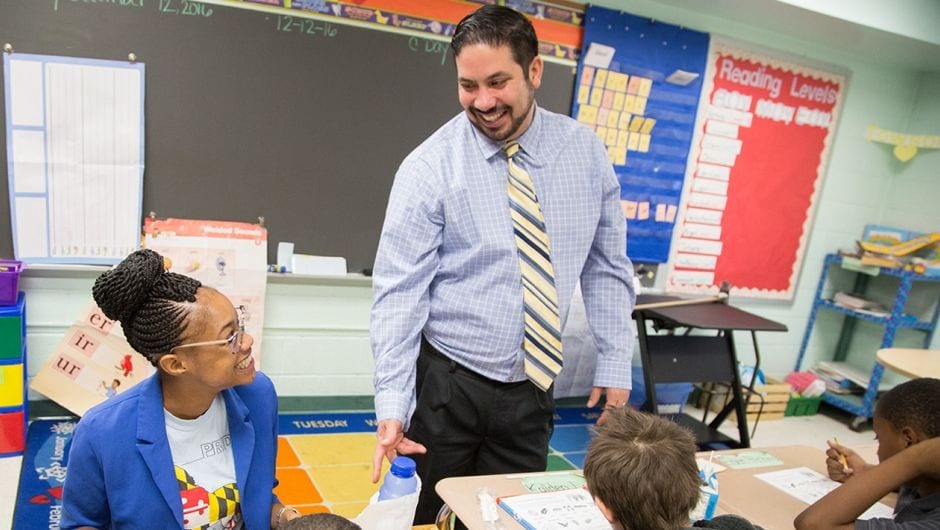
Teach For America alumni have blazed new paths as founders of YES Prep, KIPP, IDEA Public Schools, Rocketship, and Citizens of the World Charter Schools, to name a few. Today 1,440 Teach For America alumni are principals, assistant principals, and deans leading schools across the country. They are running high performing schools, helping turn around low-performing schools, launching new schools, growing existing networks, and some are working to reimagine school entirely.
A recent analysis of the Center for Research on Education Outcomes (CREDO) student growth data gives a window into the impact of TFA alumni school leaders. It shows that charter management organizations with TFA alum school leaders achieved 84 additional days of learning in reading and 52 additional days of learning in math beyond what students’ prior test scores would predict.
Hundreds of Teach For America alumni are founding and leading social ventures with children and families at the center, fueling change in classrooms, schools, and beyond.
A 2011 study by researchers from Harvard Graduate School of Education and the American Enterprise Institute concluded that more founders and top leaders of entrepreneurial education organizations started their careers with Teach For America than anywhere else.
Today, four out of five alumni work full time in education or careers that impact low-income communities. Among them are 1,200 school systems leaders, leading districts, state departments, and state boards of education, working together and alongside many others to create to produce better outcomes for more children.
Communities across the country are making meaningful progress in educational outcomes, and TFA alumni and corps members are playing an essential role, working alongside many others. Here are just a few examples.
In 2005, Tennessee ranked in the bottom fifteen states for fourth-grade math. In 2010, the state was one of two to win the first federal “Race to the Top” innovation grant. Today, Tennessee has been one of the fastest improving states since 2011 according to the National Assessment of Educational Progress (NAEP). Teach For America’s force of 1,000 leaders across Nashville has played an essential role in fueling change across the state:
Since 2001, the high school graduation rate of children growing up in the Rio Grande Valley has climbed from 78% to 92%. Student outcomes continue to rise and more and more children have access to academic opportunities such as advanced placement courses. In the last 10 years, AP/Dual Credit course completion has grown from 23% to 43%, and the percentage of students in the Rio Grande Valley who enroll into higher education after high school has increased from 49% to 60%.
Teach For America placed its first corps of teachers in the Rio Grande Valley in 1991, and has become an integral part of the community’s effort to expand educational opportunity for children there. Around 260 alumni and corps members live and work in the Rio Grande Valley, and over 85% of our alumni work directly in education, more than half as K-12 teachers.
The educational challenges our country faces are deeply rooted. Solving them will take many interventions from many directions over a prolonged period of time.
Teach For America’s contribution to the effort is leadership. Our approach draws on lessons of what enduring change requires:
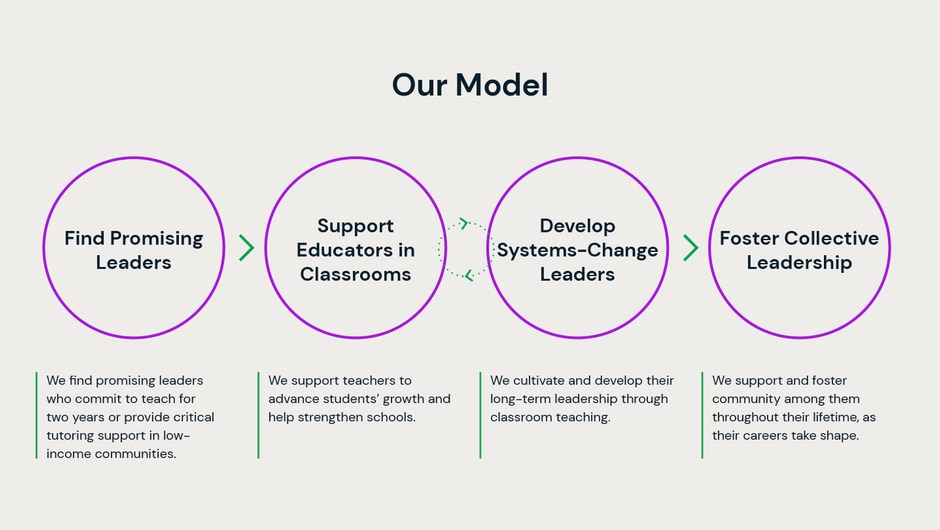
We recruit extraordinary leaders early in their careers and ask them to make a commitment that begins with two years of teaching in an under-resourced school.
We seek people who have the values and experiences necessary to expand opportunity and access for children. Among the leadership traits we look for is a deep belief in the potential of every child, a strong record of achievement, and perseverance in the face of challenges.
Since 1990, more than 72,000 extraordinary leaders have joined TFA. They’ve brought energy and imagination into classrooms in rural and urban communities.
Today, 58% of corps members identify as people of color and 65% come from low-income backgrounds. More than 1,000 corps members and alumni were themselves taught by a TFA corps member when they were students.
We develop teachers who go beyond traditional expectations to advance students’ academic and personal growth while helping to strengthen their schools.
In partnership with schools, local universities, other organizations, and businesses in the communities where we work, we provide corps members with initial training, ongoing professional development, and access to an unparalleled resource and support network.
Today, 4,100 corps members reach over 270,000 students in more than 1,800 schools across America. They teach all grade levels and subject areas.
TFA is among the largest sources of educators serving schools in low-income communities, and among the largest sources of STEM teachers.
Through teaching, corps members form relationships with children, families, and fellow educators. Their impact with students deepens their conviction and allows them to develop a richer understanding of what students need to learn and thrive.
At the same time, corps members better understand the institutional barriers that limit access to opportunity and the unique assets and challenges in their communities. They grow the skills and mindsets to effect change.
“This has changed my DNA. I’m going to be doing this work for the rest of my life.”
Informed and inspired by their students, TFA alumni remain life-long advocates for educational excellence for all. Many choose to continue teaching. Many others take on school and district leadership, launch enterprises, or enter other fields that shape the opportunities available to children, like law, healthcare, policy-making.
Today, 57% of TFA alumni work full-time in education. Among our alumni, there are:

Alumni and corps members work together and alongside many others to drive progress in communities. They’re colleagues working toward shared goals in schools. They’re co-founders working to bring a big idea to life. They’re on the same school board representing different neighborhoods. They’re staffing congressmen on opposite sides of the aisle. They’re organizing campaigns and working to change laws together.
The TFA network is part of a broad coalition united around educational excellence for all.
We strengthen the network by bringing alumni together to learn from one another and debate ideas. We share stories of progress, triumphs, and setbacks. We recognize outstanding educators, social entrepreneurs, civic leaders, and schools. We connect alumni to career opportunities and to each other. We spark conversations on accelerating the pace of change in communities.
Read more about the impact we’re having in classrooms and communities.
Teach For America is part of a global network of independent organizations developing leadership in classrooms and communities to ensure all children can fulfill their potential. Teach For All provides us a platform to connect and learn from network partners around the world.
Learn more about Teach For All.
Check your inbox for a welcome email and make sure to confirm your subscription!
Log in