Teaching Transformed My Arts Career
Some of the best artists we know used to be teachers. We talked to four Teach For America alumni now working in museums, film, arts advocacy, and design. They all say the same thing. The classroom didn't just make them better at their craft. It changed what they thought their craft could do.
Address Systemic Gaps with Arts Education
In her classrooms, Rebekah Danae learned that creativity is one of the best ways to expand opportunities, especially when students aren’t getting what they need through traditional approaches.
Rebekah Danae (Greater Tulsa ’14)
I come from West Texas. A remote desert town built around the oil industry. It was a strange mix of dirt, isolation, and unbelievable wealth. Art allowed me to make sense of the world I lived in. I studied fine art in college because it was my deepest passion and I had only begun to realize it could be a career. I was painting things I was proud of, experimenting with technology, but after graduating, I entered a (necessary) creative block. I applied to the Peace Corps and Teach For America. I thought long and hard over my decision, and chose to teach in Tulsa through Teach For America. Choosing Tulsa set the next chapter of my life in motion.
Teaching in North Tulsa taught me how to build with a community by listening first. I had to understand what my students and their families wanted from their schools and neighborhoods, not simply impose my own ideas about what education “should” be. In my English classroom, students were reading at many different levels, so I leaned into visual learning—graphic novels, collaborative hallway quilts, even turning the whiteboard into large-scale drawings and prompts that pulled my students into the room. I saw how creativity unlocked confidence and agency, especially when I started Disrupt, an afterschool mural project. Students who were often labeled disruptive were invited to lead mural projects and create art that could positively disrupt the communities we call home.
The relationships and possibilities that emerged through that work profoundly shaped my artistic life. In Tulsa, I began practicing 'social sculpture' through community organizing—though I did not have that language for it at the time. Now, as the founder of A Creative House, my work as a visual artist is inseparable from community, collaboration, and the desire to build structures that bring people together. Tulsa and the classroom changed the scale of what I believed art could do.
Design with Community, not Around It
For Scott Faris and Tracy Truels, creativity grew out of deep relationships—showing them that meaningful work starts with listening to the community and designing alongside them.
Scott Faris (South Dakota ’08)
I grew up in West Virginia, in the heart of Appalachia, surrounded by natural beauty but always feeling out of sync with the culture. What saved me early on was being exposed to the arts, especially film. I knew from a young age that storytelling through images was something I couldn’t shake. After film school at NYU, I thought I’d head straight into the industry, but the idea of being a cog in the Hollywood dream machine never sat right with me. So when someone suggested Teach For America, it landed at exactly the right moment. I applied, chose South Dakota, and ended up teaching 5th grade on the Rosebud Reservation in St. Francis, South Dakota.
The thing that stays with me most from those years is how deeply the community shaped the way I showed up. We were welcomed into cultural practices like sweats and smudging, and we learned from elders who would come into our classrooms to teach language and history. At the same time, I was bringing music into my lessons every day—playing guitar in the mornings, breaking down pop songs with my students. Incorporating art while immersing myself in such a rich culture and distinct landscape changed how I thought about the role of storytelling, whose voice matters, and what it means to honor a place.
Now, as a co-founder and documentary filmmaker at Universe Creative, those same skills and mindsets guide every project. Documentary filmmaking is a craft and a responsibility. I enter communities as a learner and collaborator, not an extractor. I elevate stories that help people see themselves and their communities with pride. I try to honor people’s identities, histories, and brilliance—just like my students taught me to do. I never left education. I just use a different medium.
“I try to honor people’s identities, histories, and brilliance—just like my students taught me to do. I never left education. I just use a different medium.”
Tracy Truels (Chicago-NW Indiana ’02)
As a kid in Oklahoma City, I didn’t grow up going to art museums. What I did have were a couple of art camps taught by teaching artists at a nearby college. That was my first real introduction to inquiry‑guided art experiences. Following my curiosity without a fixed endpoint felt fantastic. Over time, writing became my primary medium, a passion that carried through my English degree and into my 2002 move to Chicago with Teach For America.
My first year, I co‑taught K–6 writing classes with nearly every teacher in the building. It was chaotic and wonderful. But two pivotal milestones really stuck with me. One was when the Hug‑a‑Book Foundation came in to do readers’ theater, where students read directly from a script and use their vocal expression to bring the story to life. One of my favorite moments was seeing one of my quietest students light up as he performed just one line. The other moment was when I introduced Socratic circles. Watching my third graders challenge each other and build on ideas showed me that my role was to cultivate spaces that inspire curiosity and agency. I wanted to empower students to find their voices and drive change in society.
Now, as Director of Learning and Interpretation at the Philbrook Museum of Art, that’s the heart of my work. Museums can feel like they’re meant for a certain kind of person, and I want to push against that by creating spaces where people feel proud, curious, and connected. Everything I design is rooted in inquiry and belonging—just like my classroom. Whether it’s our third‑grade partnership with Tulsa Public Schools or a gallery conversation, I’m still building learning with people. And when we do that well, they walk out knowing this place is for them.
Leverage Creativity as a Leadership Skill
For Rachel McGrain, creativity became a leadership framework—guiding how she builds programs, influences policy, and expands access to the arts across Maryland.
Rachel McGrain (Baltimore ’13)
I love Maryland. It’s always been my home. I grew up in Columbia, went to Howard County Public Schools, and had what I now understand was an incredible arts education. I started trumpet in fourth grade, did theater, dance, piano—just all of it. Back then, I assumed everyone had that kind of access. It wasn’t until college, tutoring in Prince George’s County, and studying history, that I started to understand the educational gaps present in our systems. That’s what pushed me toward Teach For America and why I wanted to stay close to home in Baltimore.
My placement school had one visual art teacher. That was it. I remember looking around, thinking, this isn’t okay. So even as a math teacher, I started finding ways to bring the arts in—field trips, performances, anything free I could get my hands on. The moment that changed everything was taking students to see Detroit ’67. Many had never seen live theater. Watching them completely absorbed made it clear: one‑off experiences weren’t enough.
I had a music background—why wasn’t I using it? So I built a music program myself. I collected instruments from friends and started ensembles. I even launched a drumline when my old band director offered me a full set of drums! I loved seeing students discover parts of themselves no one had seen before.
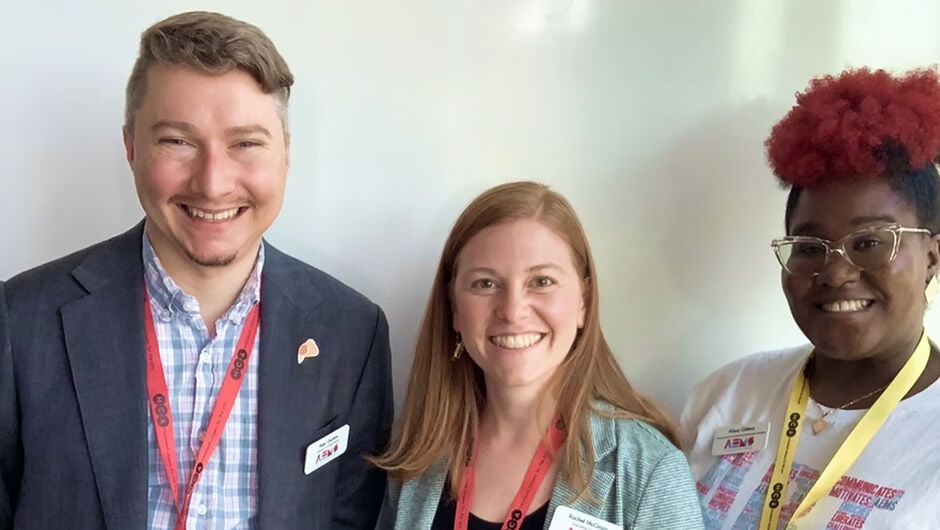
Now, as Executive Director at AEMS (Arts Education in Maryland Schools), I draw on those classroom years constantly. I understand teachers’ roadblocks—fighting to prioritize the arts in school. The lack of resources. The way arts programs can disappear overnight. I also understand the power of the arts, because I watched students transform because of it. I built a program, fundraised, and mobilized the community to make art education accessible for kids who’ve never had it. When I advocate for including the arts in education policy, it’s not abstract for me. It’s personal and rooted in the belief that every child should have robust and meaningful arts education opportunities, like I had growing up.
Tips for Effective Arts Ed Advocacy - By: AEMS
Your advocacy can transform a child’s education. Use your voice—download the ABC’S for Effective Arts Advocacy provided by Arts Education in Maryland Schools Alliance.
Try a Different Approach to a Creative Career
Early exposure to the arts shaped how these alumni saw themselves, but teaching showed them how to turn those interests into purpose. Ask alumni who are now art activists, Grammy-winning performers, talented graphic designers, and collegiate arts educators; they’ll echo the same point. Arts‑driven teaching not only improved their students' engagement but it also reshaped their careers and leadership. Now it’s your turn to use imagination to shape what’s possible for students and for yourself.